

這應該是我第一次,也是我為數不多,會用中文寫的文章。只是希望藉由分享我自己的經驗,能帶給讀者一點點啟發,或許更好一點,帶給你/妳一點溫暖,一點點希望。
另外,我在寫這篇文章的時候是混著一半中文一半英文寫的。我是土生土長的台灣人,但我就只是習慣這樣子說話而已。如果唸起來不是很通順,還請見諒。
Continue reading 往返陰陽之間這應該是我第一次,也是我為數不多,會用中文寫的文章。只是希望藉由分享我自己的經驗,能帶給讀者一點點啟發,或許更好一點,帶給你/妳一點溫暖,一點點希望。
另外,我在寫這篇文章的時候是混著一半中文一半英文寫的。我是土生土長的台灣人,但我就只是習慣這樣子說話而已。如果唸起來不是很通順,還請見諒。
Continue reading 往返陰陽之間This will be a post different from regular game design-related content. It’s merely a tale that spans over the course of a few weeks, but I hope anyone who’s reading this can find a little bit of inspiration, or even a little bit of hope and light into your life.
Also, this post is originally written in a mixture of English and Chinese. That’s just how I speak I guess.
Continue reading Life Being PositiveFirst, there was a stalk market — a simple system that allows Animal Crossing players to benefit from buying and selling turnips. To put simply, it’s a form of investment;
Then, there is Warren Turnip, a Discord bot I wrote that helps me and my friends keep track of our selling prices every day so we can benefit the most from each other.

At perhaps the same time (even earlier), came Turnip.exchange, a website that lets everyone on the internet post about their islands and set queues for investors to wait in. It is a beautiful system!
Finally, someone was smart enough to make priority queues for those who joined their Discord servers…
Continue reading Taking Bell Investments To the Next Level: Brainstorming Financial Products in Animal CrossingWhen we look at Diablo, we don’t really see it as a game under the open-world genre. Rather, it is has its own genre (although scarcely defined on Wikipedia as dungeon-crawler). Why is that?
Note: While this article may reference other material, it mainly focuses on the Diablo series, and especially Diablo 3. Also, I’m just a casual player, so my experience with the game may largely differ from others.
I want to start by attacking straight on point: the world.
The world is basically how the game’s levels are structured. Wikipedia crowns the world of Grand Theft Auto III as the prime example of modern open-world games. If we look at the game, plus a few other titles that are more often regarded as open-world games (such as Breath Of the Wild, Skyrim, Red Dead Redemption), we’ll easily notice that all these games share a common feat: it’s main level is a seamless map. I used the term “main” for players spend the majority of their time on it. Meanwhile Diablo, Path of Exile and other dungeon crawling games, the loading in between levels are simply obvious.
But seamless map design is not the criterion here, or at least it doesn’t stand as a deciding factor alone. I’d argue Super Mario 64 (and Odysssey) are open-world games; the key factor here, I think, is what exists in the “unimportant” areas. These areas can include space that has been visited already, or in a large open world, space that has absolutely no reason to visit (i.e. no quests) in order to finish the game. In Breath of the Wild, you visit different locations to get Korok seeds, which has been proven not required to save Hyrule; similarly, you don’t need to deliver pizzas to protect New York City in Spider-man 2. When compared to the main objective (saving Hyrule, protecting NYC), these content are additional and irrelevant to the main plot, but adds flavor and breadth to the experience.

If games are “voluntary attempts to overcome unnecessary obstacles“, then I argue that open-world games are collections of “voluntary attempts to overcome unnecessary obstacles and attractions“.
Looking back at Diablo and Path of Exile, one will immediately understand that these two games (and perhaps the genre itself) stands at the opposite end of the spectrum. In both of these games, each act is a series of maps of similar aesthetics and minions, and these maps all serve to convey a single plot, which translates into a single objective. When the plot in the area is completed, the game prompts you to move on to the next act, and there is no reason for you to revisit the area anymore. In other words, there are no attractions. While this allows writers to develop stories easier, it also results in a lot of the map’s potential to go into waste.
That being said, I must add that Path of Exile actually has unnecessary attractions, namely the Blight and Vaal Chambers. The blight is especially interesting since it adds an additional layer of tower-defender on top of the core dungeon-crawling gameplay.

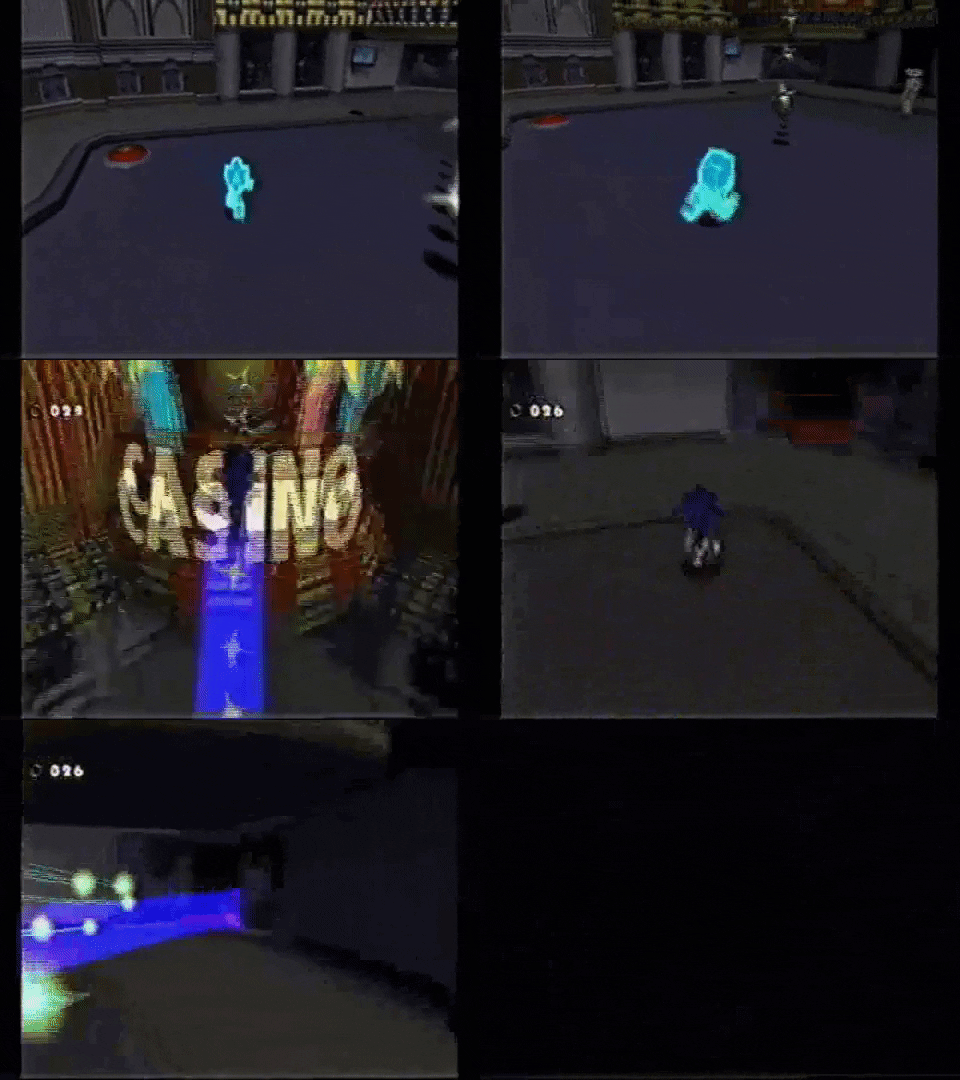
This also reminds me of one particular game: Sonic Adventure (1998). It features open areas where players can explore, but there’s hardly anything else that could be recognized as unnecessary attempts (except Chao Garden and Twinkle Circuit). It may have a large map, but I wouldn’t call it an open-world game.

One may argue that players must travel around the city to gain certain key upgrades, such as the keystones to Windy Valley or the Light-speed Shoes upgrade (required to enter Casinopolis); while it is true that players have to traverse the map, they are all necessary effort as you need these items to proceed / clear the next stage. Once these items are obtained, most of the map goes to waste.

Now I must ask myself: how do I make a dungeon-crawling experience more open-world-like (pardon the word chains)? The problem here is that if we were to take out the world structure of Diablo, then it loses its signature; so, we must consider keeping the structure as a design restriction.
I wonder if any games can provide inspiration?
In my experience with open-world MMORPGs: Blade and Soul, Black Desert Online, World of Warcraft and such, daily quests are mainly tools to keep the players in the game, but they are also great opportunities for players to revisit areas.

The problem here is that daily quests feel pretty much the same, and can easily drain players’ interests. I like to play MMORPGs because I can explore the world and try out different subsystems in the game (like cooking and such), but I never bothered grinding on daily quests; that being said, I believe the success of such design largely depends on how the game (including maps, combat, encounters) are designed to handle daily quests, but that’s a branch of story for another time.
If Diablo decides to implement such quest system, I would consider it as a “direct approach” to add attractions to the playground.
The title pretty much says it all — both of these games re-use their levels to tell a different story. In NieR: Automata, you revisit the abandoned cities as you unravel the cruel fact behind humanity’s disappearance; in Undertale, you revisit the world with a different approach in order to navigate yourself into a different branch of story.

This may sound interesting, but writing great stories just for the sake of using levels in a new way is unsustainable, especially for a live-service game. I would argue that if a team were to implement this strategy, they would need an infinite amount of Toby Fox’s to pull it off, for obvious reasons.
But what if the world in which Diablo takes place works in a particular way that requires players to find things?
The Flowering Nose is a 2004 browser game by Seth Fisher and Omar Waly. It features a similar level layout to Diablo, especially the use of isometric projection.
The fun thing about this game, however, is how the world defines the process of going to another level: players must put an object on a receiver tile; the portal then opens a gateway to a corresponding level. This means that players will go to levels like “strawberry level” or “cake level”.

If you fall down a hole, you don’t die — instead, you go to level hell.

Then, the story requires you to go to all these different levels, and figure out a way to open the locked door seen on the first level you enter. Here, the objective is clear, but the world itself is a huge attraction for players to explore and experience.

What if Diablo takes a similar approach?
Here’s an idea I think Diablo (or any other suitable game) can work on. This idea is first seen, by me, in a long-forgotten game called I Am Legend: Survival.
I Am Legend: Survival is a 2007 online multiplayer game hosted on Second Life, presumably used as a marketing boost for the actual movie. Players pick one of the two factions (humans and zombies). While the goal of the zombie faction is obvious — eliminate humans — humans must work through the entire city and find the ultimate cure.
What’s special about this cure is that it’s the combination of several unknown objects in the world. It can be anything. To validate the results, labs are established scarcely across the huge map, and zombies can temporarily take down these locations. The key point here is that players must travel the world, collect items, combine them, and validate the results to win the game. The world, again, is an attraction. Additionally, players had competed against each other to be the first to the cure, even if the game did not specify such rule.
In other and short words, this is a great competitive multiplayer idea that incorporates map usage and attractions. It is also a competitive multiplayer that requires more of the players’ uptime than their skills.
Here’s my imagination if Diablo III draws from this design (note that these are just concepts and thus doesn’t attempt to align with the Diablo Lore):
Of course, this would possibly prompt for a total redesign of the item system in Diablo (in which the only items are equipment). Nevertheless, this may transform the Diablo game into a more open-world experience, without hurting the main game loop and story much.
Anyways, thanks for reading all this babble! Let me know what you think.
If you haven’t played the game and are planning to do so, I suggest you to look away. Spoilers beyond this point.

I’m going to post this nice picture here to avoid innocent souls being spoiled.
Continue reading “Devotion” to Puzzle Design and Indirect ControlI started playing RuneScape in 2005, shortly after it’s second version just launched. My experience with MMORPG was very little, and the only other MMORPG I played was Maple Story (when online games are deemed “useless, harmful and cost unnecessary cash” by my mother, which are all painfully true). After completing all the free missions and countless hours of grinding I made myself a “considerable” fortune; the problem was that this fortune was barely usable, since at that time the only ways to spend that money were either purchasing items from NPCs or trading with random players, who will probably only accept the request if you offer ridiculously more than expected.
Then in 2007, a new feature was implemented in to the game — the Grand Exchange. Essentially it collects all the needs and offers across all servers, and let’s players to purchase items through a price decided by the market. This allows players to get what they want for a reasonable price, and also allows sellers who want really wanted to sell items an easier way to find the correct customers instead of wandering around in the world inefficiently.
MMORPGs nowadays all have similar trading systems. For example, Blade and Souls has the exactly same market system that allows players to put their items on sale for the entire community.
Before I begin, I want to take a brief moment to share my insights on life itself first.
You’ve probably asked yourself this question as well: why can’t we grow backwards and be the younger self?
Growing up is actually not bad. As time goes by, you grow physically stronger, and mentally more mature. You get to learn a lot of stuff, understand things in different ways, and most importantly, from all the things that you’ve taken and absorbed from the world, you form your own identity. That’s something no-one’s going to take away from you.
Continue reading “Can We Not Grow Up?”: A Thought On Progression in Meaningful Game DesignAfter taking a gigantic leap back to the First Great War, the Battlefield franchise finally returns to where the series actually started – World War II. While many criticized the game of its unoriginal online gameplay compared to its predecessor Battlefield I, I am much more disappointed, and therefore curious, of the absence of the Sino-Japanese War.
In 1937, soon after the Marco Polo Bridge Incident, Japanese Forces launched a full-scale invasion on China, and quickly they’ve captured major cities such as Shanghai and Nanjing. The Chinese Forces did not see its counterattack until 1939, and since then the conflict remained stalemate until the Attack on Pearl Harbor, which led the US to officially join the great war.
It is not difficult to understand why World War II gets a lot of attention, even after three decades: it is a gigantic collection of tragedies, heroism and legends of blood and tears. This makes it even more bizarre to see the Asian Theater under-represented in public media, especially in the market. What happened? Why did no-one make a video game on this theme?
Continue reading An Unsung War: The Missing Of China and Japan In Modern WWII Games


